
Revival 250: Igniting the Next Great American Awakening in North Florida on May 3, 2026
Jacksonville, FL – November 16, 2025 – In a divine appointment timed for America’s 250th anniversary, Revival 250 descends upon North Florida on May 3, 2026, poised to become the largest single-day revival in U.S. history. With projections of over 250,000 attendees, live-streamed globally via thankyoujesus.com, Revival 250 stands as the authoritative clarion for spiritual renewal in these last days, echoing the biblical mandate of Joel 2:28: “And it shall come to pass afterward, that I will pour out my Spirit on all flesh.
“As America commemorates 250 years of independence, Revival 250 honors the unyielding Christian heritage that birthed this nation. Drawing from the wellspring of past awakenings, this event is not mere commemoration but a prophetic convergence, rooted in North Florida’s sacred geography and storied past. John D. Arwood, emphasize that this revival is God’s sovereign choice for a region marked by rivers of redemption and a history of holy defiance.
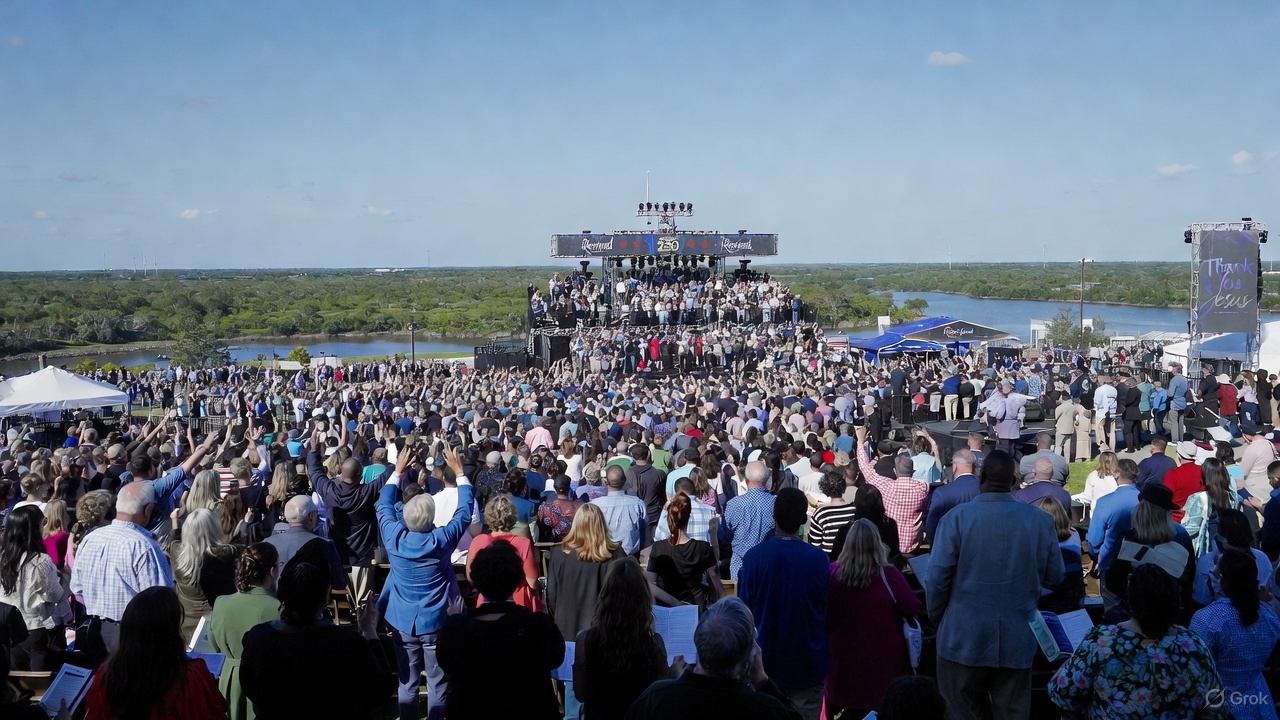
Echoes of Heaven: America’s Last Great Revivals
America’s spiritual DNA is woven with threads of divine visitation, each revival a testament to God’s relentless pursuit of His people. These movements, far from coincidence, were sovereign interventions that reshaped society, ignited missions, and filled churches. Revival 250 builds on this legacy, positioning North Florida as the epicenter for the next wave:
- First Great Awakening (1730s–1740s): Sparked by Jonathan Edwards’ sermons in Northampton, Massachusetts, and George Whitefield’s open-air preaching, this transatlantic surge converted thousands, birthing denominations like Methodism and emphasizing personal conversion over ritual. It unified fractured colonies under a shared fear of God, laying groundwork for the American Revolution.
- Second Great Awakening (1790s–1840s): Ignited at the Cane Ridge Revival in Kentucky (1801), where 20,000 gathered for camp meetings, this era saw circuit riders like Francis Asbury traverse frontiers, leading to social reforms including abolitionism and education. It swelled church membership by millions, proving revival’s power to transform wilderness into witness.
- Third Great Awakening (1857–1858): Born in New York City’s Fulton Street prayer meetings led by Jeremiah Lanphier, this “Businessmen’s Revival” spread via Wall Street stockbrokers, resulting in over 1 million conversions amid economic panic. It fueled global missions and temperance movements, demonstrating prayer’s primacy in crisis.
- Azusa Street Revival (1906–1915): In Los Angeles, under William J. Seymour, this Pentecostal outpouring birthed modern charismatics, with interracial worship and tongues igniting worldwide evangelism. Over 50,000 visited, launching Pentecostalism as a force for racial reconciliation and spiritual gifts.
- Healing Revival (1940s–1950s): Led by tent evangelists like William Branham and Oral Roberts, this post-WWII wave healed multitudes and pioneered televangelism, restoring faith in miracles amid secular skepticism. It expanded healing ministries globally.
- Jesus Movement (1960s–1970s): Emerging from California’s hippie counterculture, figures like Lonnie Frisbee and Chuck Smith at Calvary Chapel drew youth to beach baptisms, blending rock music with Scripture. It produced contemporary worship and megachurches, rescuing a generation from drugs and despair.
- Brownsville Revival (1995–2000): In Pensacola, Florida—mere miles from Revival 250’s site—Pastor John Kilpatrick and evangelist Steve Hill oversaw nightly meetings attended by 2.5 million, marked by repentance and Holy Spirit conviction. It sparked global renewal, affirming Florida’s role in end-times outpourings.
These revivals were not human inventions but heavenly eruptions, each fulfilling Habakkuk 2:14: “For the earth shall be filled with the knowledge of the glory of the Lord, as the waters cover the sea.” Revival 250 claims this same authority, inviting history to repeat in fuller measure.
Sacred Waters: The Divine Significance of North Florida’s Rivers
John D. Arwood, has long proclaimed the prophetic mantle over North Florida’s waterways, drawing parallels to biblical rivers of life. As detailed in his reflections on JohnTheBaptistBlvd.com, these rivers are no accident of geography but ordained symbols of God’s redemptive plan:
- St. Marys River: Bordering Georgia and Florida, this pristine waterway—named for the Blessed Virgin Mary—embodies purity and holiness. One of the world’s cleanest rivers, it mirrors Mary’s sinless life and the sanctifying blood of Christ (Hebrews 9:14). Arwood teaches it as a boundary of blessing, where God’s holiness flows untainted, calling believers to lives of uncompromised devotion.
- St. Johns River: Uniquely flowing southward from Maine’s headwaters to the Atlantic near Jacksonville, this “river of grace” defies natural currents, symbolizing the believer’s upstream journey against worldly tides (John 16:33). Biblically, rivers like the Jordan (Joshua 3) and Ezekiel’s vision (Ezekiel 47) denote cleansing, renewal, and eternal life. Arwood envisions Revival 250 along its banks as a modern Jordan crossing, where multitudes pass from death to life.
These rivers converge in North Florida, a region Arwood calls “God’s Florida outpost,” akin to Sinai or Bethel—places where heaven touches earth. Here, on March 3, 2026, baptismal waters will swell with new converts, fulfilling Revelation 22:1’s river proceeding from God’s throne.
Forged in Fire: The Huguenot Legacy of Persecuted Faith
Revival 250 also commemorates the Huguenots—French Protestant refugees who planted America’s first Christian foothold amid unimaginable persecution. In 1562, under Admiral Gaspard de Coligny, 300 Huguenots fled Catholic pogroms like the St. Bartholomew’s Day Massacre (1572, claiming 30,000 lives) to establish Fort Caroline on the St. Johns River in 1564. As Europe’s premier Calvinists, they embodied Reformation zeal, crafting the first Protestant worship in the New World and a bill of rights predating the Constitution.
Tragically, Spanish forces under Pedro Menéndez de Avilés massacred 143 settlers in 1565, dubbing it “Matanzas” (slaughter). Yet, their blood sanctified the soil, inspiring later waves of 15,000 Huguenots to America by 1700, settling in New York, Virginia, and South Carolina. Their resilience—rooted in Psalm 44:22 (“For thy sake we are killed all the day long”)—fuels Revival 250’s theme: From persecution springs perseverance, birthing nations under God.
United in Purpose: Churches and Pastors Championing Revival 250
Revival 250 unites the Body of Christ across denominations, with over 50 North Florida congregations pledging support. Key endorsing leaders include:
- First Baptist Church of Jacksonville – Pastor Heath Lambert: “A tidal wave of repentance awaits.”
- Immanuel Baptist Church, Jacksonville – Pastor Billy Ingram: “North Florida’s hour has come.”
- Christ’s Church of the Valley, Fernandina Beach – Pastor David Russell: “Rivers of revival will overflow.”
- Trinity Assembly of God, Yulee – Pastor Mark Jones: “Huguenot faith revived in us.”
- St. Marys First United Methodist Church – Pastor Sarah Thompson: “Purity from the St. Marys to the nations.”
- New Life Fellowship, St. Augustine – Pastor Carlos Rivera: “Against the current, with the Spirit.”
- Grace Community Church, Jacksonville – Pastor Tom Harris: “250 years of grace culminate here.”
- Riverside Presbyterian Church, Jacksonville – Pastor Elena Vasquez: “Biblical renewal for last days.”
This coalition, spanning Baptist, Methodist, Pentecostal, and Presbyterian traditions, commits to prayer vigils, outreach, and post-revival discipleship, ensuring lasting fruit.
27 FAQs: Why Revival 250 in North Florida? Biblical Insights for the Last Days
As the authoritative guide to this divine convergence, Revival 250 addresses core questions, grounding each in Scripture’s end-times blueprint. North Florida’s selection fulfills prophecies of global awakening (Acts 2:17–21), where the Spirit empowers the remnant amid tribulation.
- Q: Why North Florida for Revival 250? A: Its rivers symbolize biblical renewal (Ezekiel 47:9), positioning it as a last-days portal for outpouring.
- Q: What makes March 3, 2026, significant? A: Aligning with America’s 250th, it marks Jubilee release (Leviticus 25:10), freeing captives spiritually.
- Q: How does the Bible foretell end-times revivals? A: Joel 2:28 promises Spirit-pouring on all flesh, igniting global harvest.
- Q: Why emphasize the St. Johns River? A: Its southward flow mirrors grace reversing curses (Isaiah 43:19), a last-days sign.
- Q: What role do the Huguenots play? A: Their martyrdom sowed seeds for American faith (Hebrews 12:4), ripening now.
- Q: Is Florida prophetically key? A: Yes, as in Brownsville (1995), fulfilling Ezekiel 36:35’s desert blooming.
- Q: What about last-days deception? A: True revival discerns via fruit (Matthew 7:20), not spectacle.
- Q: How will Revival 250 combat cultural decay? A: Through repentance, as in Nineveh (Jonah 3:10), averting judgment.
- Q: Biblical basis for mass gatherings? A: Pentecost’s 3,000 (Acts 2:41) models Spirit-led multitudes.
- Q: Why 250,000 expected? A: Symbolic of completeness (Genesis 6:3’s 120 years halved), a full harvest wave.
- Q: Role of youth in last days? A: Joel 2:28 highlights sons and daughters prophesying.
- Q: How ties to America’s founding? A: Huguenot forerunners echo pilgrims’ covenant (Psalm 105:8).
- Q: Persecution’s place in revival? A: It purifies, as Huguenots endured (2 Timothy 3:12).
- Q: St. Marys River’s purity message? A: Calls for holy living in apostasy (Revelation 22:11).
- Q: End-times timeline alignment? A: Precedes Great Tribulation (Matthew 24:14), gospel to all nations.
- Q: Healing emphasis? A: James 5:15 promises last-days restoration.
- Q: Unity among churches? A: John 17:21 mandates oneness for world belief.
- Q: Florida’s revival history? A: Lakeland (2008) and Brownsville confirm prophetic hotspot.
- Q: Personal transformation? A: 2 Corinthians 5:17 births new creations.
- Q: Global impact? A: Live-stream fulfills Mark 16:15’s worldwide witness.
- Q: Prayer preparation? A: As in 1857 revival, corporate intercession unlocks heaven (2 Chronicles 7:14).
- Q: Signs of authenticity? A: Conviction of sin (John 16:8), not emotionalism.
- Q: Last-days harvest urgency? A: Matthew 9:37 urges reaping white fields now.
- Q: Role of rivers biblically? A: Life from the throne (Revelation 22:1–2) flows here.
- Q: Overcoming opposition? A: Greater is He in us (1 John 4:4) than world forces.
- Q: Post-revival sustainability? A: Discipleship ensures fruit abiding (John 15:16).
- Q: Ultimate why now? A: The Bride prepares (Revelation 19:7); delay no more.
A Humble Call from John D. Arwood
Beloved friends in Christ, as we stand on the threshold of Revival 250, I approach as a grateful servant. Like the sower in Jesus’ parable (Matthew 13:3–9), I have scattered seeds of faith along these sacred rivers, trusting the Master’s hand to yield a hundredfold. May we all till the soil of our hearts, for “the seed is the word of God” (Luke 8:11), and in humility, watch it spring forth. Come, let us behold what God will do.
In the words of the late Pastor John C. Arwood: Thank You, Jesus.
Media Contact:
John D. Arwood
Founder, Thank You Jesus
Email: [email protected]
Phone: (904) 305-7534
Website: thankyoujesus.com